

Ozempic Butt: What It Is, and How to Prevent (or Reverse) It

# Ozempic Butt: What It Is, and How to Prevent (or Reverse) It
*The muscle and shape changes that come with rapid GLP-1 weight loss aren’t inevitable. Here’s what’s actually happening to your body — and what Pilates and strength training can do about it.*
—
If you’re on Ozempic, Wegovy, Mounjaro, or Zepbound — or you’re considering starting — you’ve probably heard the phrase “Ozempic butt.” Maybe a friend has mentioned it. Maybe you’ve started to notice it in yourself: jeans that used to fit are loose in unexpected places, your glutes feel flatter, your reflection at a lower weight doesn’t look quite the way you imagined it would.
This isn’t a vanity problem. It’s a body composition problem with real consequences for your strength, your posture, your metabolism, and how you’ll age. The good news is that it’s largely preventable — and even if it’s already started, it’s reversible. This post explains what’s actually happening in your body, why traditional advice (squats and protein shakes) is incomplete, and what the most effective approach actually looks like.
## What is “Ozempic butt”?
“Ozempic butt” is the informal term for the flattening, sagging, or deflated appearance of the glutes that some people experience during rapid weight loss on GLP-1 medications. It’s not unique to Ozempic — the same thing happens with Wegovy, Mounjaro, Zepbound, and any other GLP-1 medication that produces fast, significant weight loss.
The visible change is real, but the underlying cause is what matters: **you’re losing muscle along with fat**, and the glutes happen to be one of the largest muscle groups in the body. When fat in that area diminishes quickly while the underlying glute muscles also atrophy, the result is a flatter, less-defined shape.
The same process is also happening in other places you can’t see as easily — your arms, your back, your thighs, even your bone density. “Ozempic butt” is just the most visible manifestation of a body-wide change.
## Why does this happen on GLP-1 medications?
The mechanism is straightforward. GLP-1 medications work by slowing digestion and dramatically reducing appetite. When you eat less while your body still needs energy to function, it pulls that energy from stored tissue. Without specific signals to *preserve* muscle, your body breaks down both fat and lean tissue — and the proportions are surprising.
**Research consistently shows that 15% to 40% of total weight lost on GLP-1 medications can come from lean muscle mass and bone**, not fat. In some studies, the lean-mass loss is even higher in patients who lose weight quickly without exercising.
This is fundamentally different from how the body loses weight through diet and exercise alone, where the muscle-to-fat ratio of loss is much more favorable. GLP-1 medications produce remarkable results — but they don’t discriminate between the tissue you want to lose and the tissue you don’t.
## Why this matters beyond appearance
It’s tempting to treat Ozempic butt as a cosmetic concern, but the underlying muscle loss has consequences that show up over years rather than weeks:
– **Slower metabolism.** Muscle is metabolically active tissue. Losing it lowers the rate at which your body burns calories at rest, which makes maintaining weight loss harder over time.
– **Decreased bone density.** Rapid weight loss is associated with measurable losses in bone mineral density, especially in the hips and spine. This raises fracture risk later in life.
– **Weaker posture.** The muscles that hold you upright — the glutes, back, and deep core — are the same ones most at risk. Many GLP-1 patients notice their posture deteriorating without understanding why.
– **Higher injury risk.** Weaker muscles and bones make everyday movement riskier, from carrying groceries to climbing stairs.
– **Functional decline.** The strength to stand from a chair, lift a child, or hike on vacation comes from the muscle groups that GLP-1 medications can quietly erode.
None of this is inevitable. It’s preventable. But it requires the right kind of intervention.
## Why the standard advice (“just do squats”) is incomplete
Most articles about preventing Ozempic butt recommend the same generic prescription: strength training, focused on glute work, with adequate protein. The exercises listed are usually squats, lunges, deadlifts, and hip thrusts — performed two to three times per week.
This advice isn’t wrong. It’s just incomplete, and it doesn’t account for the realities of GLP-1 treatment.
**The problem with generic strength training during GLP-1 treatment is that your body isn’t operating at full capacity.** Energy is lower. Appetite is suppressed. Nausea is common in the first months. Sleep is sometimes disrupted. Recovery is slower because protein intake is harder to maintain.
In this context, traditional high-load gym work — heavy squats, deadlifts with significant weight — can be difficult to sustain consistently. Patients start strong, miss workouts when side effects flare, and lose the consistency that actually drives muscle preservation.
What works better for most GLP-1 patients is a different model of strength training: **lower-impact, adjustable, joint-protective, and built around the body’s actual capacity that day**. That’s where Pilates — specifically classical Pilates on apparatus — becomes uniquely valuable.
## Why classical Pilates is especially effective for GLP-1 patients
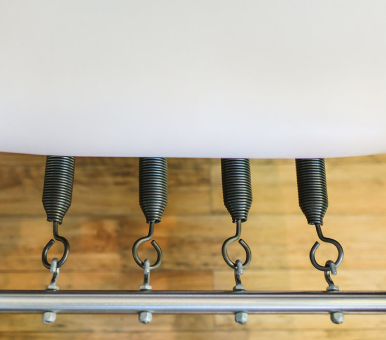
Classical Pilates on apparatus (the Reformer, Tower, Cadillac, and Chair) is fundamentally **spring-resisted strength training** — but with characteristics that make it especially well suited to bodies on GLP-1 medications.
**Adjustable resistance.** Spring tension can be increased or decreased instantly to match what your body can handle on a given day. A bad day on Ozempic doesn’t mean skipping the workout — it means working with lighter springs and adjusting intensity, while still getting the muscle preservation signal.
**Heavy posterior chain focus.** Classical Pilates is built around the glutes, hamstrings, back, and deep core — exactly the muscle groups most at risk during rapid weight loss. Many of the foundational exercises (footwork on the Reformer, leg springs on the Tower, bridging variations) are direct glute work, often more targeted than gym-based squats or lunges.
**Bone-loading work.** Standing exercises on the Reformer and Chair, plus weight-bearing apparatus work in general, provide the kind of bone-stimulating load that helps preserve bone density during weight loss — the second silent consequence of GLP-1 treatment that most exercise advice doesn’t address.
**Low impact, joint-protective.** No jumping. No pounding. No heavy free weights compressing the spine on a day when your energy is depleted. The spring resistance does the work, which makes it sustainable on the days when traditional gym training would feel impossible.
**Whole-body integration.** Pilates trains the body as a unit, which preserves the functional strength that lets you move well at any weight. Generic glute work in isolation can build the glutes back up, but it doesn’t restore the integrated strength that makes you feel like yourself.
**Precise instruction.** Classical Pilates is typically taught one-on-one or in tiny groups, with an instructor watching and correcting your specific body. This matters more than usual during GLP-1 treatment, when body composition is shifting and what worked last month may not be right for this month.
## What a complete preservation strategy actually looks like
Pilates alone isn’t enough for every GLP-1 patient. The most effective approach combines several elements, working together:
**1. Resistance training, at least 2–3 times per week.** Classical Pilates on apparatus is ideal as the foundation, with optional supplemental work (free weights, resistance bands, or additional apparatus sessions) layered in depending on rate of weight loss and starting strength.
**2. Adequate protein intake.** Most clinical sources recommend 1.2 to 1.6 grams of protein per kilogram of body weight daily — significantly more than the standard recommendation, and harder to hit when appetite is suppressed. Smaller, protein-rich meals throughout the day work better than trying to consume large meals.
**3. Slower weight loss when possible.** Working with your prescribing physician to find the lowest effective dose, or to slow weight loss when it’s happening faster than your body can adapt, reduces muscle and bone loss significantly.
**4. Bone-loading movement, not just muscle work.** Standing, weight-bearing exercise (walking with intention, stair climbing, Pilates work on the apparatus that involves standing or partial weight-bearing) helps preserve bone density.
**5. Coordination with your medical team.** Most physicians prescribing GLP-1 medications are actively encouraging their patients to strength train. Letting them know what you’re doing — and where — helps them adjust your treatment for the best outcome.
## What if Ozempic butt has already happened?
If you’re reading this and noticing the changes already, the news is mostly good: muscle is rebuildable. It takes longer to rebuild than it took to lose, but with consistent resistance training and adequate protein, the glutes (and other muscle groups) can recover substantially.
What’s harder to reverse is what happened to your bone density and the underlying body composition baseline. The earlier you start the work, the more you preserve and the less you have to rebuild. The best time to begin was when you started the medication. The second best time is now.
For some patients with significant volume loss, cosmetic options exist — fat grafting, body contouring, and similar procedures — but most patients don’t end up needing them when they start preservation work early enough. The plastic surgeons writing about Ozempic butt online have a financial interest in framing it as a surgical problem. For the majority of GLP-1 patients, it’s a movement and nutrition problem with a movement and nutrition solution.
## How to start
The right starting point depends on your situation. If you’re just starting GLP-1 treatment, building a movement practice now — before significant weight loss begins — is the highest-leverage move you can make. If you’re already mid-treatment, starting now still produces meaningful results, just with more rebuilding involved. If you’re approaching maintenance dose or coming off the medication, the work shifts toward locking in your gains and preventing rebound.
What matters most is consistency. Two to three sessions per week, sustained over months, will preserve significantly more muscle and bone than sporadic intensity. The goal isn’t to push through — it’s to show up regularly and let the work compound.
—
*Endurance Pilates and Yoga in Boston’s South End offers specialized Pilates and strength training for patients on GLP-1 medications. Founder Julie Erickson is a master classical Pilates instructor (Romana’s, STOTT, Balanced Body), certified personal trainer (NASM, ACE, AFAA), certified nutrition coach (CNC), and is currently completing a specialized GLP-1 nutrition credential. Boston Magazine’s Best of Boston Personal Trainer.*
***[Learn more about our GLP-1 specialty practice →](/glp1-pilates-boston/)***
***[Book a consultation →](https://clients.mindbodyonline.com/classic/ws?studioid=9133&stype=-8)***